
Table of Contents
Belief in angels in Muslim religion is one of the six pillars of faith (Iman), forming the foundation of Islamic theology. These celestial beings, created by Allah from light, serve as obedient servants who never disobey His commands. Unlike humans or jinn, angels are entirely spiritual, invisible to the human eye, and play vital roles in the universe—from delivering revelation to recording deeds and executing divine will.
The Islamic View of Angels
angels in Muslim religion (mala’ika) are pure beings created by Allah to fulfill specific tasks. They do not possess free will and are incapable of sin. The Qur’an states:
“They do not disobey Allah in what He commands them but do what they are commanded.”
(Qur’an 66:6)
Unlike other belief systems, Islam does not recognize “fallen angels.” Satan (Iblis) is not an angel but a jinn, created from smokeless fire. Angels are always obedient, glorifying Allah day and night without fatigue.
How Angels Are Portrayed in Folklore and Iconography
Islamic tradition avoids visual depictions of angels, respecting their sacred and unseen nature. While Western art often portrays angels with human features and wings, Islamic sources describe them as majestic beings with multiple wings and immense size. The Prophet ﷺ once described an angel carrying Allah’s Throne whose distance between earlobe and shoulder equals a 700-year journey.
At Quranbycall.com Academy, we believe that understanding the unseen elements of faith such as the role of angels in Islam—is essential to deepening one’s spiritual connection. Our courses are thoughtfully designed to provide authentic, accessible Islamic education, including topics like angelology, Ruqqya, and Qur’anic sciences. Whether you’re a beginner or seeking advanced knowledge, our expert instructors guide students through structured lessons that combine classical sources with modern learning tools. Join us to explore the beauty of Islamic belief and strengthen your journey with knowledge rooted in revelation.
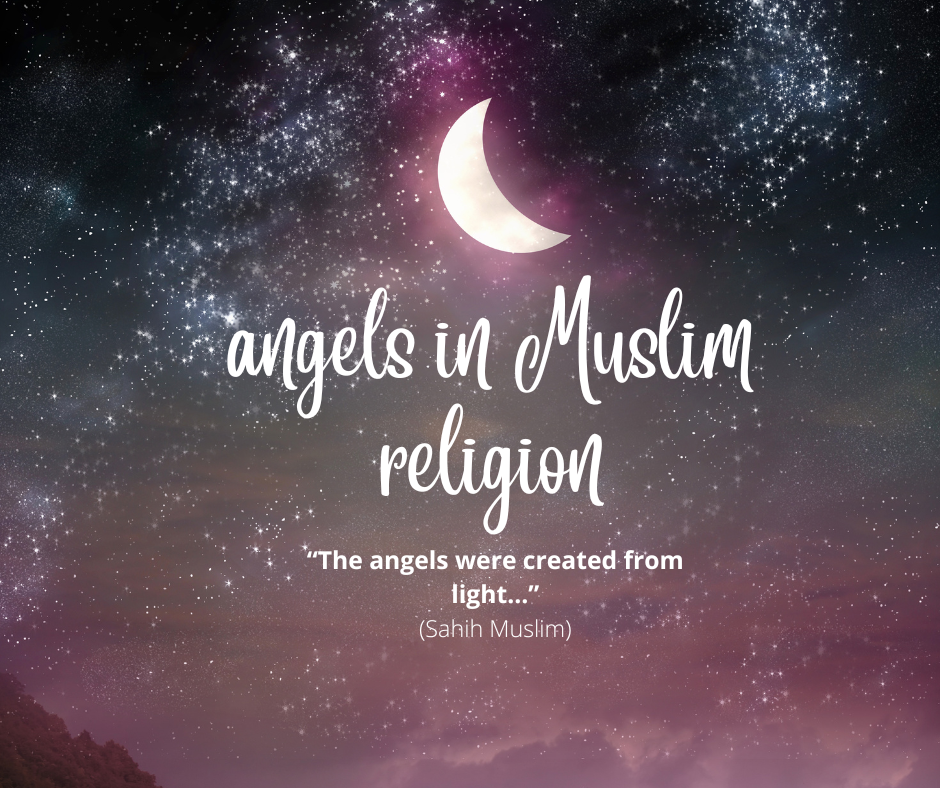
Angels Were Created From Light
The Prophet Muhammad ﷺ said:
“The angels were created from light…”
(Sahih Muslim)
This divine origin sets angels apart from other creations. Their luminous nature symbolizes purity, obedience, and spiritual power.
The Number of Angels
The exact number of angels is known only to Allah. However, Islamic texts suggest their numbers are vast and incomprehensible. For example, the Bayt al-Ma’mur, a heavenly sanctuary above the Kaaba, is visited daily by 70,000 angels who never return, followed by another group.
The Names of angels in Muslim religion
Several angels are mentioned by name in the Qur’an and Hadith. These include:
- Jibril (Gabriel) – Bringer of revelation
- Mika’il (Michael) – Overseer of sustenance and rain
- Israfil – Blower of the trumpet on Judgment Day
- Malik – Guardian of Hell
- Ridwan – Keeper of Paradise
- Munkar & Nakir – Questioners in the grave
- Raqib & Atid – Recorders of deeds
Each angel has a distinct role, reflecting the divine order and justice of Allah.
Angelic Abilities
Angels possess extraordinary abilities granted by Allah:
- They can take human form (as Jibril did when visiting Mary and Prophet Muhammad ﷺ)
- They travel between realms instantly
- They record every word and action of humans
- They never tire of worship and glorification
These abilities emphasize their role as divine agents and protectors.
Tasks of The Angels
Angels perform a wide range of tasks, including:
- Delivering revelation to prophets
- Recording human deeds (good and bad)
- Protecting believers
- Administering natural phenomena like rain and wind
- Blowing the trumpet to signal the Day of Judgment
- Guarding Paradise and Hell
- Questioning souls in the grave
Their roles are essential to the spiritual and physical order of the universe.
20 Names of Angels in Islam and Their Duties
Here are 20 angels and their known responsibilities:
| Angel Name | Duty |
|---|---|
| Jibril | Conveying revelation to prophets |
| Mika’il | Managing rain and sustenance |
| Israfil | Blowing the trumpet on Judgment Day |
| Izra’il | Taking souls at death |
| Munkar | Questioning in the grave |
| Nakir | Questioning in the grave |
| Raqib | Recording good deeds |
| Atid | Recording bad deeds |
| Malik | Guardian of Hell |
| Ridwan | Guardian of Paradise |
| Hamalat al-‘Arsh | Carrying the Throne of Allah |
| Zabaniyah | Angels of punishment in Hell |
| Harut & Marut | Angels sent to Babylon (Qur’an 2:102) |
| Kiraman Katibin | Honorable scribes recording deeds |
| Mu’aqqibat | Guardian angels protecting humans |
| Angel of Mountains | Tasked with controlling mountains (mentioned in Hadith) |
| Angel of Death’s Helpers | Assisting Izra’il in soul collection |
| Angel of Mercy | Bringing comfort to believers |
| Angel of Punishment | Bringing torment to disbelievers |
| Angel of the Trumpet | Israfil, awaiting command to blow trumpet |
FAQs of angels in Muslim religion
1. Do Muslims believe in angels?
Yes. Belief in angels is a core pillar of Islamic faith.
2. Can angels be seen by humans?
Generally, no. Only prophets have seen angels in their true form.
3. Are angels male or female?
Angels are genderless spiritual beings.
4. Do angels have free will?
No. They only do what Allah commands.
5. Is Satan a fallen angel?
No. Satan (Iblis) is a jinn, not an angel.
6. How many angels are there?
Only Allah knows their exact number, but they are countless.
7. What is the role of Jibril?
He delivered divine revelation to prophets.
8. Do angels record our deeds?
Yes. Raqib and Atid record every action and word.
9. What happens when we die?
Izra’il takes the soul, and Munkar and Nakir question the deceased in the grave.
10. Can angels take human form?
Yes, with Allah’s permission, as seen in the stories of Mary and Prophet Muhammad ﷺ.