
Understanding major and minor mistakes in Tajweed is crucial for anyone seeking to recite the Holy Quran correctly. This highlights the importance of learning Tajweed, which is defined as giving every letter its due right and characteristic in terms of articulation point and attributes.
Scholars of Quranic recitations have divided recitation errors into two main types: clear errors (Lahn Jali – Major) and subtle errors (Lahn Khafi – Minor).
Major errors, or Lahn Jali, are obvious mistakes that change the structure, meaning, or grammatical inflection of a word. They can be detected by anyone who knows Arabic, not just specialists in this field. Its ruling is religiously forbidden (Haram) if the reciter does it intentionally, because it alters the meanings of the Holy Quran, such as adding or omitting a letter or a word from a verse.
Minor errors, or Lahn Khafi, are mistakes that affect the beauty, elegance, and perfection of recitation and its precise rules, without changing the essential meaning. They are usually only noticed by specialists and scholars. Its ruling is disliked (Makruh) and it diminishes the perfection of the recitation, such as neglecting Ghunnah or not observing its correct duration.
Key takeaways:
What you will read in this article:-
Table of Contents
- Why Learning Tajweed is Essential
- Major vs. Minor Errors: Understanding the Difference
- How to Avoid Common Tajweed Mistakes
- Improve Your Recitation with the QuranByCall
What is “Lahn” in Quran recitation
There are two types of Lahn : major and minor mistakes in Tajweed
- linguistically: Lahn means deviation or straying from what is correct.
- Technically: it is defined as a mistake or deviation from the correct rules of recitation and the proper pronunciation of the Holy Quran.
What are the causes of Lahn?
- Lack of knowledge of Tajweed rules.
- Failure to distinguish between the articulation points (Makharij) and characteristics (Sifaat) of letters.
- The reciter being influenced by a local dialect or non-Arabic languages.
- The reciter’s haste and lack of direct learning from a qualified teacher (Mushafahah).
It is important to know and avoid Lahn in order to protect the tongue from making mistakes in the Words of Allah and to ensure that the act of worship is performed correctly and acceptably, and you only can avoid this through learning Tajweed.
Major mistakes in Tajweed (A-lahn Al-jaly)
There are major and minor mistakes in Tajweed. Let’s first start with major mistakes(A-lahn Al-jaly).
The word “Jali” means clear and apparent. We can define Lahn Jali (major mistake) as an error that occurs in words and corrupts the structure of the word, its grammatical inflection (I’rab), or its intended meaning.
The Reason for its name: It is called Jali because it is obvious and can be detected by Tajweed scholars and by anyone who knows the Arabic language.
Its Islamic ruling: It is religiously forbidden (Haram) if done intentionally while one is able to learn its correction. Among its dangers is that it invalidates the prayer if it changes the meaning in Surah Al-Fatiha, for example. Therefore, it is obligatory to change and correct it immediately.
Common examples of major mistakes
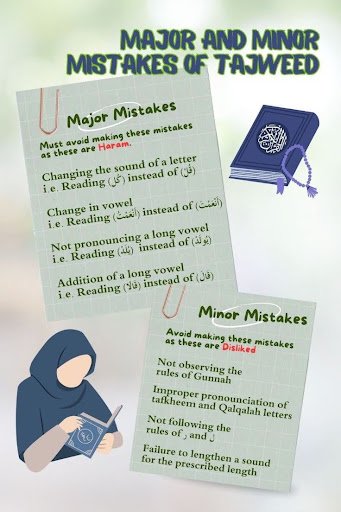
Major mistakes include four main forms: replacing letters, changing vowel marks (Harakat), adding or deleting letters, and changing a Sukoon into a Harakah and vice versa.
- Replacing a letter with another letter
This means changing a letter to another one that is close to it in articulation point (Makhraj and Sifaat errors, rulings of Lahn Jali), which completely changes the meaning of the word.
Examples:
– Reading عَسَى with صـ to become عَصَى
– Reading الْحَمْدُ with هـ to become الْهَمْدُ
– Replacing ذ with ز as if it were زَيْن
- Changing grammatical vowel marks (I’rab):
This is replacing a Dammah, Fathah, or Kasrah with another Harakah, which leads to confusing the subject with the object or changing the speaker.
Examples:
– Changing a Fathah to a Dammah: أَنْعَمْتَ becomes أَنْعَمْتُ
– Changing a Kasrah to a Fathah: إِيَّاكِ instead of إِيَّاكَ
- Adding or deleting a letter from a word:
This is generating a new Madd letter due to exaggeration in Makhraj, or deleting an original letter from the verse.
Examples:
– Lengthening the Harakah (Matt): Prolonging the Dammah of the Kaf in كُنْتُمْ to become كُونْتُمْ (adding a non-existent Waw Maddiyah).
– Deleting a letter: Shortening Madd As-Silah or deleting an original Madd letter in a word, such as reading قَالُوا without the Alif and Waw to become قَالُ
- Moving a Sakin letter or making a moving letter Sakin:
This is giving a Harakah to a Sakin letter or making a moving letter Sakin, which disrupts the weight and eloquence of the word.
Example:
– Making the moving Kaf Sakin in إِيَّاكَ نَعْبُدُ instead of clearly opening it with Fathah.
Minor mistakes in Tajweed (Al-lahn Al- khafy/اللحن الخفي)
The Two Main Types of Errors in Tajweed
Errors in Tajweed are divided into two main categories: major and minor mistakes in Tajweed
Second: The Minor mistake, known as Lahn Khafy
Meaning of the word “Khafy“: It means hidden and not apparent to the general public.
Technical Definition: It is an error that occurs in the pronunciation of words, which affects the perfection and beauty of the recitation, without changing the meaning or the grammatical structure of the word.
Why it is called “Khafy“: Because it can only be detected by scholars of Tajweed and specialists who have mastered this science.
Its Ruling in Shariah: It is considered makruh (disliked) and is seen as a deficiency in the perfection of recitation and quality of performance. However, it does not invalidate the prayer, nor does it alter the religious meaning of the verses.
Causes of this error:
- Failure to give the letters their full due regarding complementary characteristics.
- Excessive speed in recitation, which leads to neglecting the proper duration of Madd and Ghunnah.
How to avoid Lahn Khafy:
- Precise learning through direct oral transmission from a proficient teacher.
- Focusing on controlling the timing of the rules.
- Training the tongue through consistent practice.
Common examples of minor mistakes
Minor errors are usually related to pronunciation, complementary characteristics of letters, or neglecting precise Tajweed rules, without changing the word or its meaning.
Examples:
1- Failure to give the doubled Noon or Meem, or cases of Ikhfa and Idgham, their full right of resonance and duration, such as reading “إِنَّ” or “ثُمَّ” with a quick pronunciation without showing Ghunnah from the nasal cavity, or not showing Ghunnah in Ikhfa like “مِن قَبْلُ”.
2- Not adhering to the measures of Mudud, such as shortening the obligatory Madd or exceeding its correct limit, or not unifying the timing of Mudud during recitation, such as:
– Shortening Madd Muttasil or Munfasil to only two harakahs instead of four or five, such as reading “جَاءَ” or “قَالُوا أَنفُسَهُمْ”.
– Exaggerating the natural Madd to more than two harakahs.
3- Neglecting Tafkheem and Tarqeeq, i.e., making a heavy letter light or a light letter heavy while the letter itself remains without turning into another letter, such as making Raa or Laam of the word Allah light in places of Tafkheem, like reading “قَالَ اللهُ” with a light Laam.
4- Leaving or weakening Qalqalah, by not showing the light bounce in the letters Qaf, Taa, Baa, Jeem, and Daal when they are saakin, such as pronouncing the saakin Baa in “قُلْ أَعُوذُ بِرَبِّ الْفَلَقِ” or the Daal in “قُلْ هُوَ اللهُ أَحَدٌ” when stopping on it without a clear Qalqalah bounce.
5- Not controlling the rules of Ith-har, Ikhfa, and Idgham, such as the harsh Ith-har of the Meem Saakinah at Waw and Faa in “عَلَيْهِمْ وَلَا” in a way that cuts the sound chain.
Key differences: major and minor mistakes in Tajweed

| Comparison point | Major error | Minor error |
| What it is | Changes the letter ,vowel ,or the whole meaning | Doesn’t change meaning only affects beauty and perfection |
| Example | Reading “An’amta” as”An’amtu” | Reading “Min Qablu” without Ghunnah |
| Who notices it | Anyone can notice it even non- specialists | Only Tajweed teachers and specialists notice it |
| Ruling | Haram ,must be fixed, can invalidate prayer | Makruh (disliked) considered as a lake of perfection |
| Simple summary | Change what you read | Changes how well you read |
How to avoid Tajweed mistakes in your recitation
There are major and minor mistakes in Tajweed, and to avoid both, several methods should be followed.
- Direct Learning from a Certified Teacher
Tajweed is a science learned through direct oral transmission. A proficient teacher can listen to your recitation, pinpoint your weaknesses, and immediately correct your articulation points and both major and minor errors. Start your Tajweed learning journey now through our website.
- Continuous Listening to Master Reciters
Listening attentively and precisely to renowned master reciters known for their Tajweed perfection, such as Al-Husary, Al-Minshawy, and Abdul Basit, is highly important. It helps the ear and tongue automatically absorb correct pronunciation and the precise durations of Madd and Ghunnah through imitation.
- Gradual Learning and Starting with the Basics
Do not rush to learn advanced rules before mastering the fundamentals. First, focus on perfecting the articulation points of letters and their vowels to avoid major errors, then move on to studying the rules of Noon, Meem, and Madd to avoid minor errors.
- Daily Practice and Tongue Exercise
Daily training and tongue exercises play a major role. Tajweed is a practical skill that depends on repetition.
- Slow and Measured Recitation (Tarteel)
Avoid excessive speed while reading.
- Self-Recording and Reviewing Your Recitation
Recording your own recitation, listening to it carefully, and comparing it with a proficient reciter’s recitation helps you discover hidden errors that you may not notice while reading itself.
Master Quran recitation with QuranByCall
If you want to master the recitation of the Holy Quran and to avoid major and minor mistakes in Tajweed, start your journey now with QuranByCall.
If you face difficulties committing to Tajweed institutes or fear making major errors without a teacher to correct you, the solution is to register on our website. We provide proficient, certified teachers in a direct live call to correct your recitation step by step.
– The ability to learn anytime and anywhere online.
– Learning with expert teachers who are masters of Tajweed rules and certified in the Quran.
– We also have customized learning plans, whether you are a beginner looking to get rid of Lahn Jali (major errors) or advanced and want to master Lahn Khafi (minor errors) and achieve Ijazah.
What benefits will the learner get from learning Tajweed?
– Building confidence while reciting the Quran in prayer and in front of others.
– Rapid and tangible progress from hesitation to proficient Tarteel.
– Saving time and effort while ensuring high quality of direct oral transmission.
Start your journey to mastering the Holy Quran today.
Book your first trial session with QuranByCall now!
Conclusion
In conclusion, mastering major and minor mistakes in Tajweed is a gradual journey.
- The difference between Lahn Jali and Lahn Khafi is that, first, Lahn Jali (major error) must be eliminated immediately because it corrupts the meaning and grammar. As for Lahn Khafi (minor error), it is the stage of perfection and beautification that gives the recitation its beauty and adornment without affecting the meaning.
- You must know that Tajweed is not merely theoretical; it requires continuous oral transmission from a teacher and daily practice to train the tongue.
- Remember that the reward for learning Tajweed is a great and ongoing reward for mastering the words of Allah, as mentioned in the Hadith of the Prophet (peace and blessings be upon him) about the proficient reciter of the Quran and the one who finds it difficult.
The Prophet (pbuh) said: “The one who is proficient in the recitation of the Qur’an will be with the honourable and obedient scribes (angels) and he who recites the Qur’an and finds it difficult to recite, doing his best to recite it in the best way possible, will have two rewards.” [Sahih Al-Bukhari and Muslim]
FAQs:
What is the main difference between major and minor mistakes in Tajweed?
Lahn Jali (major mistake) changes the meaning, the structure of the word, or the grammar, and it is obvious to everyone. Lahn Khafi (minor mistake) affects the beauty of the recitation and the precise rules such as Madd and Ghunnah without changing the meaning, and only specialists in Tajweed notice it.
Do Tajweed mistakes invalidate prayer (Salah)?
Yes, Lahn Jali can invalidate the prayer if it occurs in Surah Al-Fatiha and changes a fundamental meaning, such as changing a Fathah to a Dammah in “An’amta”. As for Lahn Khafi, it does not invalidate the prayer, even if the recitation lacks precision and beauty.
What is the Islamic ruling on making major and minor mistakes in Tajweed?
Lahn Jali is Haram (forbidden) in Shariah if the reciter does it intentionally or neglects learning Al-Fatiha and the basics while being capable of learning. As for Lahn Khafi, it is Makruh (disliked) or contrary to what is preferable, and it is known mostly to proficient reciters and scholars.
How can I stop making major and minor mistakes in Tajweed?
You must first start by getting rid of Lahn Jali by learning the correct articulation points (Makharij) and vowels with a proficient teacher. To correct Lahn Khafi, you can start your Tajweed learning journey through our website.