
If you are learning to recite the Quran, you may have heard the terms Tajweed and Tarteel and wondered if they mean the same thing.They are related, but they are not quite the same.
Tajweed is about pronouncing the Quranic letters and words correctly, while Tarteel is about reciting the Quran in a calm, clear, and measured way.
Tajweed helps you pronounce the Quran correctly, while Tarteel helps you recite it without rushing. Once you understand the difference between Tajweed and Tarteel, it becomes much easier to know what you need to work on in your recitation.
What is Tajweed in Islam?
Tajweed means improvement and perfection. In Quran recitation, it refers to the rules that help you pronounce every letter correctly, giving each letter its proper Makhraj.
Tajweed rules teach you what each letter should sound like and how its pronunciation can change depending on the letters around it. It covers rules such as Noon Sakinah and Tanween, Madd, Ghunnah, Idgham, Izhar, Ikhfa, and Iqlab.
The goal is not simply to make your recitation sound better. Tajweed helps you preserve the correct pronunciation of the Quran and avoid mistakes that could affect the meaning of a word or verse.
What is Tarteel in Quran?
Tarteel means reciting the Quran in a calm and clear way, without rushing through the verses, It involves giving each word and verse its proper attention, observing suitable pauses, and maintaining a steady pace that makes the recitation easier to follow and reflect upon.
Allah says in Surah Al-Muzzammil: (And recite the Quran with measured recitation) ( وَرَتِّلِ الْقُرْآنَ تَرْتِيلا )
So, Tarteel is not simply about reading slowly, It is about taking your time with the Quran, pronouncing the words clearly, and allowing yourself to focus on what you are reciting.
Key Differences Between Tajweed and Tarteel (Side-by-side comparison)
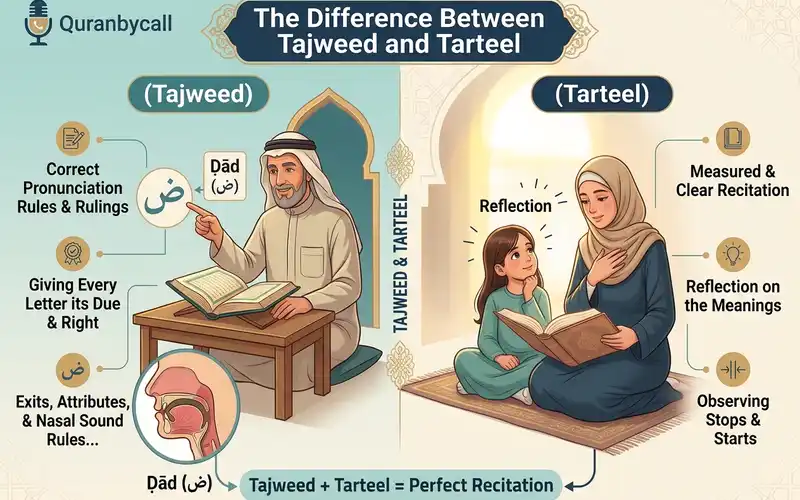
The clearest way to separate these two concepts is to compare what each one actually controls.
| Comparison | Tajweed | Tarteel |
| Definition | Rules that help you pronounce Quranic letters and words correctly | Slow, measured pace of recitation |
| Focus | Correct pronunciation, articulation, and letter characteristics | The pace, clarity, and manner of recitation |
| Purpose | To preserve correct pronunciation and avoid mistakes that may affect meaning | To give the reciter time to focus, reflect, and understand the verses |
| Can one exist without the other? | Yes. Tajweed rules can be applied whether the recitation is fast or slow | Tarteel does not replace Tajweed. You can recite with Tarteel while still following Tajweed rules |
| Quranic basis | Developed through the transmission and teaching of Quranic recitation rules | Directly mentioned in Surah Al-Muzzammil |
| What it prevents | Pronunciation mistakes that may change the meaning of a word | Rushed recitation that can make the words harder to follow and reflect upon |
Distinction Between Technique vs. Speed/Manner:
A simple way to understand the difference between Tajweed is about technique, while Tarteel is about the manner of recitation.
- Tajweed teaches you how to pronounce each letter correctly, including its proper sound and articulation.
- Tarteel is about reciting in a calm, measured, and clear way.
You can follow Tajweed rules whether you recite slowly, at a moderate pace, or more quickly.
The rules themselves do not change with your speed, although maintaining accurate pronunciation can become more challenging as you recite faster.
Is Tajweed Mandatory or Sunnah?
The ruling on Tajweed depends on which rules of recitation we are talking about. A Muslim is required to learn enough to recite the Quran correctly and avoid clear pronunciation mistakes that can change the meaning of a word or verse. This is especially important when reciting Surah Al Fatihah, as incorrect pronunciation can affect its meaning.
Other Tajweed rules relate to the detailed characteristics and articulation of letters. These rules help improve the quality of recitation, but a mistake in them does not necessarily change the meaning. Learning and applying these rules is therefore considered recommended rather than obligatory according to the scholarly distinction mentioned above.
In simple terms, avoiding pronunciation errors that change the meaning is obligatory, while learning the finer details of Tajweed to perfect the recitation is recommended.
This distinction is helpful for beginners because it allows them to focus first on reading the Quran correctly and then gradually improve their application of the more detailed Tajweed rules.
How Learning Tarteel without Changing Quranic Meaning step-by-step?
Reading slowly does not mean you are reciting correctly. You can take your time and still make pronunciation mistakes that affect the meaning. A better approach is to build Tarteel step by step while keeping your pronunciation accurate:
- Get the pronunciation right first: Make sure you can pronounce each letter and word correctly before focusing too much on your pace. A qualified teacher can help you catch mistakes you may not notice yourself.
- Start with one verse: Recite it slowly and clearly without rushing to the next verse.
- Pause in the right places: Follow the appropriate waqf signs in your Mushaf instead of stopping wherever you feel like it. The wrong pause can sometimes affect the meaning.
- Record your recitation: Listening to yourself afterward can help you notice rushed words, unclear sounds, or missed letters.
- Move forward gradually: Once you are comfortable with individual verses, start reciting short passages while keeping the same steady pace.
- Leave room for reflection: After a passage, take a brief moment to think about its meaning. Tarteel is not simply about slowing down; it is about giving the words of the Quran the attention they deserve.
Can You Have Tarteel Without Tajweed?
Yes, you can recite the Quran slowly and calmly without knowing all the Tajweed rules. But if you want your recitation to be both clear and correct, learning Tajweed is important.
Tajweed helps you pronounce the Quranic letters properly, while Tarteel encourages you to recite with a calm and measured pace. They serve different purposes, but they work well together.
You do not need to learn every Tajweed rule before you start practicing Tarteel. A good approach is to learn the basic pronunciation rules gradually and apply them as you practice reciting with Tarteel. This way, you can work on your pronunciation and your recitation style at the same time.
How to Start Reciting the Quran with Both Tajweed and Tarteel?
When you understand the difference between Tajweed and Tarteel, the best way to improve is to practice both regularly. You do not need to make your routine complicated, Start small and focus on getting each step right.
- Choose a short Surah:. Practice a few lines each day and, when possible, ask a Quran teacher to listen and correct you.
- Focus on one Tajweed rule at a time: Practice it repeatedly until applying it starts to feel natural.
- Keep a comfortable Tarteel pace: Read slowly enough to stay accurate, but do not slow down so much that your recitation becomes hesitant.
- Listen to a reliable reciter: Pay attention to how the letters are pronounced and articulated rather than trying to copy the melody.
- Record yourself regularly: Listen to your recitation afterward and look for mistakes that keep coming back. Catching them early makes them much easier to correct.
Types of Quran recitation speeds (Tarteel, Tadweer, Hadr)
When learning Quran recitation, you may come across Tarteel, Tadweer, and Hadr. They describe different approaches to the pace and manner of recitation, but they are not always treated as separate levels.
- Tarteel: This means reciting the Quran in a measured, clear, and deliberate way. It includes giving each letter its proper pronunciation and observing the rules of Tajweed.
- Tadweer: This refers to a moderate pace of recitation, It falls between the slower style of Tahqiq and the faster pace of Hadr, while still maintaining correct Tajweed.
- Hadr: This is a faster style of Quran recitation. Even at this pace, the reciter should continue to observe Tajweed rules and pronounce the letters correctly.
It is worth noting that scholars differ in how they classify these terms. Some treat Tarteel as one of the levels of recitation alongside Tahqiq, Tadweer, and Hadr. Others understand Tarteel more broadly as a quality that should be present in every type of recitation. In this view, a person can recite with Hadr, Tadweer, or Tahqiq while still maintaining Tarteel by reciting clearly and without careless rushing.
In conclusion, understanding the difference between Tajweed and Tarteel makes Quran recitation much easier to approach. Tajweed helps you pronounce the Quran correctly, while Tarteel teaches you to recite with a calm and measured pace. You do not have to choose between them. With regular practice, you can work on your pronunciation while developing a more steady and thoughtful way of reciting the Quran.
If you are still unsure about your pronunciation or how to apply Tajweed while reciting, learning with a qualified Quran teacher can make a real difference. At Quran by Call, you can learn Quran recitation step by step, with guidance that fits your level and helps you build confidence in your recitation.
Table of Contents
FAQs
Is Tajweed compulsory when reading the Quran?
Tajweed is important for learning to pronounce the Quran correctly and avoid mistakes that may affect meaning. Beginners should learn its basic rules gradually and apply them in their recitation.
What is the difference between Tajweed and Tarteel?
Tajweed focuses on correct pronunciation, while Tarteel focuses on the pace and manner of recitation. They are different, but they work together.
Can I learn Tajweed on my own without a teacher?
You can study the rules on your own, but a qualified Quran teacher can listen to your recitation and correct pronunciation mistakes that may be difficult to notice yourself.
Which one should a complete beginner learn first?
Start with the basics of Tajweed and correct pronunciation, then practice reciting with Tarteel. You can develop both gradually as you continue learning.