
Surah Al Maun in English offers a powerful reminder about sincerity, compassion, and social responsibility. This article explores its message, meaning, and practical applications, while guiding learners on how to memorize and recite it effectively.
Table of Contents
Surah Al Maun in English: The Core Message Explained
Surah Al Maun in English highlights the importance of genuine faith expressed through actions. It condemns hypocrisy, neglect of the needy, and empty rituals performed without sincerity. The Surah teaches that true belief is reflected in kindness, charity, and ethical behavior toward others. It reminds Muslims that worship is incomplete without compassion and social responsibility.
Understanding the Meaning of Surah Al Maun in English
When exploring Surah Al Maun in English, its meaning becomes clear: faith must be lived, not merely spoken. The Surah criticizes those who deny the Day of Judgment, mistreat orphans, and refuse small acts of kindness. It emphasizes that even simple gestures like offering basic help carry great spiritual value. The Surah encourages believers to embody mercy, humility, and generosity in all aspects of life.
1- The Piercing Question of Surah Al-Ma’un
“Ara-aital lazee yu kazzibu bid deen”
(Have you seen the one who denies the Recompense?)
When we hear this, we might expect a description of a tyrant, a vocal atheist, or an open enemy of Islam. But Allah gives us a chillingly different answer. He describes someone whose denial of the Day of Judgment is not proven by their tongue, but by their actions.
This sermon is not about judging others. It is about holding up the terrifying mirror that is Surah Al-Ma’un is the Surah of “Small Kindnesses” and forcing each one of us to look into it and ask a difficult question: Is my faith connected to my deeds, or have I become a mere performer of rituals?
Today, in this first part of our sermon, we will diagnose the symptoms of a faith that has become dangerously disconnected from its true purpose, as laid out for us in this powerful Surah.
2. The Anatomy of Denial: A Heart Hardened to the Vulnerable
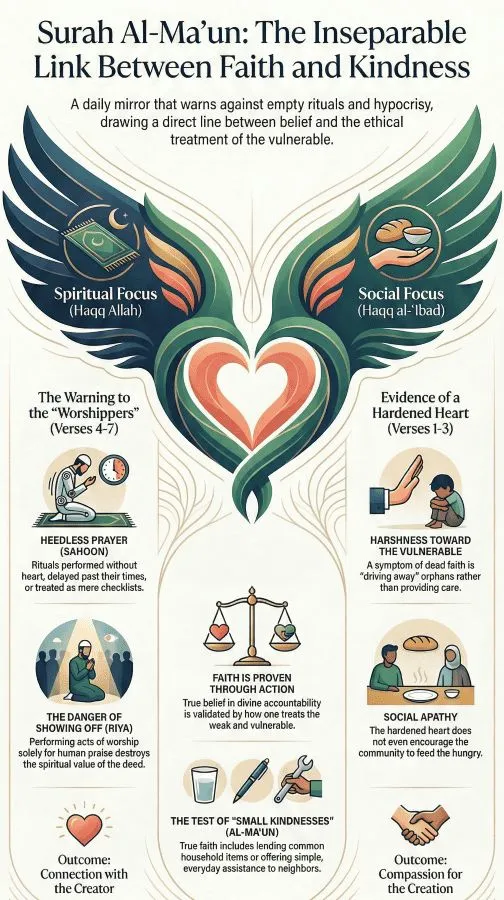
Allah (SWT) establishes a profound principle from the very outset of this Surah. The first and most telling proof of a person’s disbelief in the Day of Judgment is not a philosophical argument or a statement of atheism. It is a callousness of the heart that manifests in how we treat the most vulnerable members of our society.
The Surah describes two symptoms that expose this hardened heart:
- “For that is the one who drives away the orphan” Notice the specific verb Allah uses. He does not say the person “neglects” or “ignores” the orphan. The Arabic implies a harsh, aggressive, and public rejection. This is the action of someone who is fully aware of their power over someone weak and uses that power to push them away. In our modern context, this isn’t just about a literal orphan. It is about how we treat anyone who is powerless before us. Do we exploit the junior employee at work? Do we ignore the needs of the elderly in our family? Do we dismiss the plea of someone who is in a weaker position than us? This act of “driving away” is the first sign of a heart that does not fear accountability.
- “And does not encourage the feeding of the poor” This second symptom is even more profound. Allah condemns not only the one who fails to feed the poor but also the one who fails to even encourage others to do so. This describes a state of complete social apathy. It is a heart so deadened to the suffering of others that the sight of hunger does not move it in the slightest. It does not feel the responsibility to act, nor even the compassion to speak up and motivate the community. This is a faith that has been privatized and sealed off from the pain of the world, a faith that has become spiritually dead.
If these external actions are the proof of a hardened heart, Allah then turns His warning inward, to the very pillar of our faith that is meant to prevent this hardness our prayer.
3. The Great Warning: When Prayer Invites “Woe”
This is where the Surah pivots and becomes truly terrifying for every one of us who stands in prayer. After describing the one who denies the Recompense through their actions, Allah says:
- “Fa wailul-lil musalleen” (So woe to those who pray,) Subhan’Allah. Let that sink in. How can it be that Allah declares “Woe” is a declaration of destruction, a valley in Hellfire upon the Musalleen, the very people who perform the Salah? This verse is a stark warning that the physical act of praying is not enough. This section dissects the characteristics of a prayer that is so empty and devoid of spirit that it invites not reward, but ruin.
These worshippers are defined by three fatal flaws. These are not three separate flaws, my brothers and sisters; they are a spiritual cascade. It begins with the heart being absent from the prayer (Sahoon), which then makes the prayer an act for people instead of for Allah (Yuraa’oon), which culminates in a heart so shriveled and selfish that it cannot even perform the smallest act of kindness (Al-Ma’un).
- They are “Heedless” (Sahoon): They pray, but their heart is absent. Their prayer is an act of spiritual autopilot. The source defines this as delaying prayers past their designated times without reason, rushing through the motions as if it were a chore on a checklist, or performing the physical actions without any presence, humility, or remembrance of Allah. In our modern world, an epidemic of distraction, this is the disease of a prayer that has become a mindless ritual rather than a mindful connection.
- They “Make Show” (Yuraa’oon): This is the disease of Riya showing off. They perform their prayers and their good deeds not for the pleasure of Allah, but to be seen and praised by people. Their goal is public validation, not divine acceptance. This hypocrisy destroys the value of all deeds, turning the most sacred acts of worship into hollow performances. In the age of social media, where acts of charity and even worship can be broadcast for likes and shares, this warning is more relevant than ever.
- They “Withhold Al-Ma’un”: This is the final, damning proof. The person whose prayer is heedless and performed for show becomes so spiritually bankrupt and selfish that they refuse to give even Al-Ma’un the small kindnesses. The great companion Abdullah ibn Masud (ra) defined this as the simple things of daily use, like “lending a bucket and cooking-pot.” This is not about massive charity; it is about the most basic acts of neighborly kindness offering a glass of water, lending a tool, or even giving a smile.
This Surah paints a devastating picture of a person whose external acts of worship have become entirely disconnected from their internal spiritual state and their fundamental social responsibilities.
Applying Surah Al Maun in English to Daily Life

Surah Al Maun in English provides practical lessons that can be applied every day:
- Show kindness consistently: Even small acts matter.
- Support the vulnerable: Care for orphans, the poor, and anyone in need.
- Avoid hypocrisy: Worship should be sincere, not performed for show.
- Practice social responsibility: Contribute positively to your community.
- Be mindful of your behavior: Faith is reflected in how you treat others.
By integrating these principles, believers strengthen both their character and their relationship with Allah.
Surah Al Maun Word‑by‑Word Translation in English
A word‑by‑word look at Surah Al Maun in English helps learners understand its depth. While not providing the full text, here is a simplified breakdown of key terms:
- Ara’ayta – Have you seen
- Yukadhdhibu – Denies
- Yateem – Orphan
- Yahuddu – Does not encourage
- Miskeen – The needy
- Musalleen – Those who pray
- Sahoon – Neglectful
- Ma’un – Small acts of kindness or charity
This approach helps learners grasp the Surah’s vocabulary and meaning more effectively.
Why Quran by Call Academy Is Ideal for Learning Surah Al Maun in English
Quran by Call Academy offers a structured and engaging learning experience for students who want to master Surah Al Maun in English. Their programs stand out because:
- Certified instructors with strong expertise in Tajweed and Tafsir
- Flexible online classes suitable for all ages
- Personalized learning plans tailored to each student
- Interactive memorization techniques that make learning enjoyable
- Supportive environment that encourages consistent progress
How to Memorize and Recite Surah Al Maun in English
Memorizing Surah Al Maun in English becomes easier with a structured approach:
- Start with listening: Hear the Surah repeatedly from a skilled reciter.
- Break it into sections: Memorize a few words or phrases at a time.
- Understand the meaning: Comprehension strengthens memory.
- Practice daily: Short, consistent sessions are more effective.
- Recite aloud: This improves pronunciation and retention.
- Review regularly: Repetition ensures long‑term memorization.
Effective Memorization Techniques for Surah Al Maun in English
To master Surah Al Maun in English, learners can use these proven techniques:
- Visualization: Connect words with mental images.
- Writing practice: Rewrite verses to reinforce memory.
- Tajweed focus: Proper pronunciation enhances fluency.
- Group recitation: Learning with others boosts motivation.
- Audio repetition: Listening multiple times strengthens recall.
- Meaning association: Link each verse to its message.
Frequently Asked Questions (FAQs)
1. What is the main theme of Surah Al Maun in English?
Its main theme is sincerity in worship and kindness toward others.
2. Why is Surah Al Maun important?
It teaches that true faith requires compassion, charity, and ethical behavior.
3. How long does it take to memorize Surah Al Maun?
With consistent practice, most learners can memorize it within a few days.
4. What does “Maun” mean?
It refers to small acts of kindness or simple charitable deeds.
5. Can children learn Surah Al Maun easily?
Yes, its short length and clear message make it ideal for young learners.