
Mastering Makhraj al-Halq is essential for anyone who wants to recite the Holy Quran correctly. Every Arabic letter has a precise articulation point and characteristics that give it its unique identity. Tajweed scholars have divided the articulation points into five major areas: Al-Jawf, Al-Halq, Al-Lisan, Ash-Shafatan, and Al-Khayshum, comprising a total of 17 detailed articulation points. Among the deepest and most important of these areas is the throat area. The throat houses six of the richest and most distinctive sounds of the Arabic language, which often pose the greatest challenge for non-native speakers and beginners.
Table of Contents
Key takeaways
What you will learn in this article:-
The translation:
1-The three throat articulation points: (deepest, middle, and closest) and their six letters (Hamzah, Haa’(ه), Ayn, Haa’ (ح), Ghayn, Kha).
2-The article will cover the precise differences, common mistakes, practical exercises, and the connection of these letters to the upcoming Tajweed rule (Al-Izhar Al-Halqi).
What is Al-Halq and Why Throat Letters Matter in Tajweed
The Makhraj Al-Halq (the throat) is the vocal region extending from the top of the larynx / vocal cords at the beginning of the chest to the root of the tongue.
It is one of the five major general articulation points in the science of Tajweed.
The difference between Al-Halq and Al-Lisan is that Al-Halq is a region where sound is produced using contractions of the throat muscles, the epiglottis, and the vocal cords, without direct involvement of the lips or the tongue.
- The throat contains three specific, detailed articulation points,
and its letters are six specific Quranic letters from these three exits: Hamzah, Haa'(ه), ‘Ayn, Haa'(ح), Ghayn, and Khaa’. - These letters are called in Tajweed Al-Huroof Al-Halqiyyah (the Throat Letters).
Most of the letters that exit from the throat, especially ‘Ayn, Haa'(ح), Ghayn, and Khaa’, do not exist in the English language, which requires training muscles that are not accustomed to this pronunciation.
Relying on English letters instead of the Quranic script merges different letters into one letter, such as writing Haa'(ه)and Haa’ (ح)with the same letter ‘h’,
or omitting ‘Ayn and Hamzah, which is a major mistake that distorts the meaning.
Errors in Al-Halq cause a clear mistake (Lahn Jali) that completely changes the Quranic meaning, such as changing Ar-Raheem (الرحيم with ح) to Ar-Raheem (الرهيم with هـ).
Knowing these letters and memorizing them as one group is not just a lesson in Makharij Al-Huroof, but it is the direct foundation for the rule of Al-Izhar Al-Halqi.
When a Noon Saakinah or Tanween comes before any of these six letters, the letter Noon is pronounced with complete clarity and without an extra Ghunnah, and it is called Izhar Halqi in relation to the articulation point of these six letters.
The 3 Specific Articulation Points and 6 Letters of the Throat
The Makhraj Al-Halq (The throat) is divided into three vertical sections that ascend from the inside to the outside:
- Aqsa Al-Halq (the deepest part of the throat, closest to the chest),
- Wasat Al-Halq (the middle region),
- Adna Al-Halq (closest to the mouth).
The six letters are divided among these three regions,
with each region clearly producing two letters:
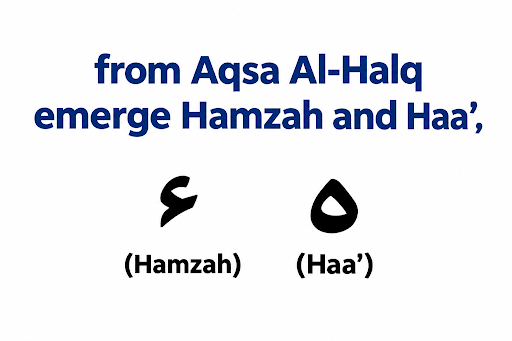
From Aqsa Al-Halq emerge Hamzah and Haa'(ه),
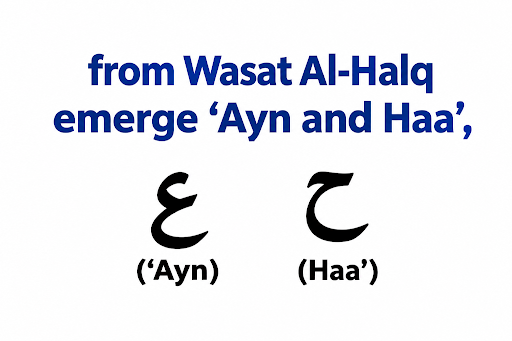
 from Wasat Al-Halq emerge ‘Ayn and Haa'(ح),
and from Adna Al-Halq emerge Ghayn and Khaa’.
 Although each pair shares the same region, they differ in vocal performance, such as holding the breath in Hamzah versus continuing the breath in Haa'(ه),
or muscle constriction and voicing (Jahr) in ‘Ayn versus whispering (Hams) in Haa'(ح).
The order of the letters begins from the deepest point of sound at the larynx, where Hamzah is articulated, ascending toward the opening of the mouth and tongue at Khaa’.
Deep, Middle, and Upper Throat: A Closer Look at Each Region
The Three Regions of The Makhraj Al-Halq (The throat):
The First Region: Aqsa Al-Halq (The Deepest Part of the Throat): it is located precisely at the deepest point of the throat, very close to the larynx.
Aqsa Al-Halq Letters:
1- Hamzah: Produced by a complete and momentary closure of the vocal cords, followed by a sudden burst of air, like a natural glottal stop.
2- Haa'(ه): Produced from almost the same point, but with a continuous flow of air without complete closure, resulting in a whispered and light sound.
The Second Region: Wasat Al-Halq (The Middle Throat): it is located exactly in the middle of the throat.
Wasat Al-Halq Letters:
1- Ayn: Produced by constricting the muscles of the middle throat with vibration of the vocal cords. It is a famous and unique sound that has no equivalent in the English language.
2- Haa(ح): Described as being produced from the same region but without vibration of the vocal cords, to be a whispered sound that carries more roughness and clarity than Haa’.
The Third Region: Adna Al-Halq (The Closest Part of the Throat)
Located at the top of the throat where the throat meets the beginning of the mouth and tongue.
The Letters:
1- Ghayn: Described as emerging with a voiced and vibrant sound accompanied by resonance and depth.
2- Khaa: Emerging from the same point with a whispered, rough, or rustling sound, similar to a slight hoarseness or throat clearing.
The six Arabic throat letters form an ascending chain of articulation, starting from the deepest part of the throat and moving gradually upward toward the mouth.
Key Characteristics of Throat Letters (Weight and Voice)
Determining the Makhraj alone is not enough. The Sifaat (phonetic characteristics) are what give each letter its tone and distinguish it from the letter that shares the same articulation point.
- Al-Isti’laa Letters (The Heavy Letters): the two letters of Adna Al-Halq, Ghayn and Khaa’, are characterized by Isti’laa and Tafkheem, where the sound fills the mouth with a deep echo.
- Al-Istifal Letters (The Light Letters): the remaining four Halqi letters, Hamzah, Haa'(ه), ‘Ayn, and Haa'(ح), are always light and clear (Muraqqaq) and must never be made heavy during recitation.
Jahr and Hams:
- Hams letters are letters of breath flow, where breath continues because the Makhraj does not close completely. They are Haa'(ه), Haa'(ح), and Khaa’, which gives them a soft, light characteristic.
- As for Jahr letters, they involve breath retention and vibration of the vocal cords. The breath is trapped and the sound appears with strength, namely Hamzah, ‘Ayn, and Ghayn.
There is a wonderful balance in The Makhraj Al-Halq (The throat). Each detailed region contains one Jahr letter and one Hams letter, such as Hamzah (Jahr) and Haa'(ه) (Hams), which helps the beginner distinguish the correct pronunciation by paying attention to the airflow and the vibration of the vocal cords.
From Al-Halq to Izhar Halqi: How Throat Letters Trigger the Tajweed Rule
The reason this rule is named Izhar Halqi is that all six of its letters are articulated from the Makhraj Al-Halq. This articulation point is the phonetic and practical basis for this Tajweed rule.
This is due to the phonetic distance: there is a significant articulatory gap between the Makhraj of Noon Sakinah and Tanween, which is the tip of the tongue, and the Makhraj of the six throat letters, which are deep in the throat.
Because the two articulation points are so far apart, making Idgham or Ikhfaa would be difficult. Therefore, the most natural and effortless pronunciation is to clearly manifest the Noon without any extra effort.
How to Apply Izhar Halqi:
Linguistically, Izhar means to clarify and make something apparent.
In Tajweed, it means that when Noon Sakinah or Tanween is followed by one of the six throat letters :- Hamzah, Haa'(ه), ‘Ayn, Haa'(ح), Ghayn, and Khaa’ , the Noon is pronounced clearly and distinctly from its own Makhraj, without any additional Ghunnah, pause, or break.
(مثل: مَنْ آمَنَ ، يَنْأَوْنَ ، مِنْ حَكِيمٍ ، سَمِيعٌ عَلِيمٌ)
Common Pronunciation Mistakes and How to Fix Them
Warm-up Exercises and Awareness of the Throat Muscles:
1- Light Yawning:
Use the yawning motion to open the back of the throat and activate the tongue and epiglottis muscles. This is excellent for the letters ‘Ayn and Haa'(ح).
2- Deep Breathing and Whispering Exercise:
By slowly exhaling with warm air from the deepest point to engage the muscles of Aqsa Al-Halq (the deepest part of the throat) without tension, for the letter Haa'(ه).
3- Gradual Training with Vowels and Sukoon:
Apply the rule of training with Sukoon preceded by Hamzah to precisely control the Makhraj.
Gradually pronounce each letter with the three vowels [Fathah, Dammah, and Kasrah ] to ensure the stability of the Makhraj in all cases.
4- Mirror and Larynx Touch Exercise:
Use a mirror and look inside the mouth to ensure the tongue is stable and not incorrectly raised when pronouncing the throat letters.
Light touch on the larynx: Gently place your hand on your neck to feel the vibration during the voiced (Jahr) letters like ‘Ayn and Ghayn, or the absence of vibration in the voiceless (Hams) letters like Haa'(ه), Khaa’, and Haa'(ح).
5- Voice Recording:
Record yourself pronouncing passages containing short Quranic verses that include throat letters, then listen back to compare your pronunciation with that of proficient reciters.
Most Importantly: While theoretical exercises and individual practice are excellent, Tajweed is a science acquired through direct oral transmission (Mushafahah). The subtle details of the throat muscles cannot be corrected except by a proficient teacher.
Start your Tajweed learning journey with certified teachers: Interactive 1-on-1 sessions with direct evaluation of your Makhaarij and Sifaat. Book your free trial session now to master the recitation of the Holy Quran with confidence and precision.
Conclusion
Mastering Tajweed and the articulation points of Makhraj Al-Halq is not merely a vocal exercise; it is a spiritual journey to give every Quranic letter its right and its due, as it was revealed to the Prophet ﷺ.
Moreover, perfecting the sounds of the throat adds clarity, humility, and a unique beauty to your recitation, transforming individual practice into an experience where the reciter truly feels the sweetness of the Quran.
While theoretical reading and individual exercises are an excellent start, Tajweed is a science acquired through oral transmission. Only the expert ear of a proficient teacher can correct the finest details of pronunciation.
Contact us to start your practical journey now with our teachers to elevate your recitation.
FAQs
What is Makharij in Tajweed?
Makharij is the plural of Makhraj, which is the precise point of articulation where a letter originates and where the sound is cut off, distinguishing it from other letters.
Its importance in Tajweed is that knowing the Makharij is the primary foundation for reciting the Quran correctly and avoiding any alteration in the meanings of the verses.
What are the 5 main Makharij?
1- Al-Jawf (The Oral Cavity): The empty space in the mouth and throat, which is the articulation point for the three Madd letters: Alif, Waw, and Yaa Maddiyyah.
2- Al-Halq (The Throat): The area extending from the larynx to the root of the tongue, from which the six throat letters emerge.
3- Al-Lisan (The Tongue): The largest and most detailed organ, which includes the middle, sides, and tip of the tongue.
4- Ash-Shafatan (The Two Lips): The outer part of the mouth, from which four letters are articulated.
5- Al-Khayshoom (The Nasal Cavity): The nasal passage extending above the roof of the mouth, which is the articulation point for the Ghunnah sound accompanying Noon and Meem.
How many Makharij are there?
The preferred and most adopted view is that there are 17 Makhaarij. This is the view of the majority of reciters, Imam Ibn Al-Jazari, and Al-Khalil ibn Ahmad, and it is the most widely taught:
– Al-Jawf: 1 Makhraj
– Al-Halq: 3 Makhaarij
– Al-Lisan: 10 Makhaarij
– Ash-Shafatan: 2 Makhaarij
– Al-Khayshoom: 1 Makhraj
Other Views:
- – The view of Ash-Shatibi and Sibawayh: 16 Makhaarij, by eliminating Al-Jawf and distributing its letters to Al-Halq, Al-Lisan, and Ash-Shafatan.
- – The view of Al-Farra’, Al-Jarmi, and Qutrub: 14 Makhaarij, by eliminating Al-Jawf and merging the Makhaarij of Lam, Noon, and Raa into a single Makhraj.