
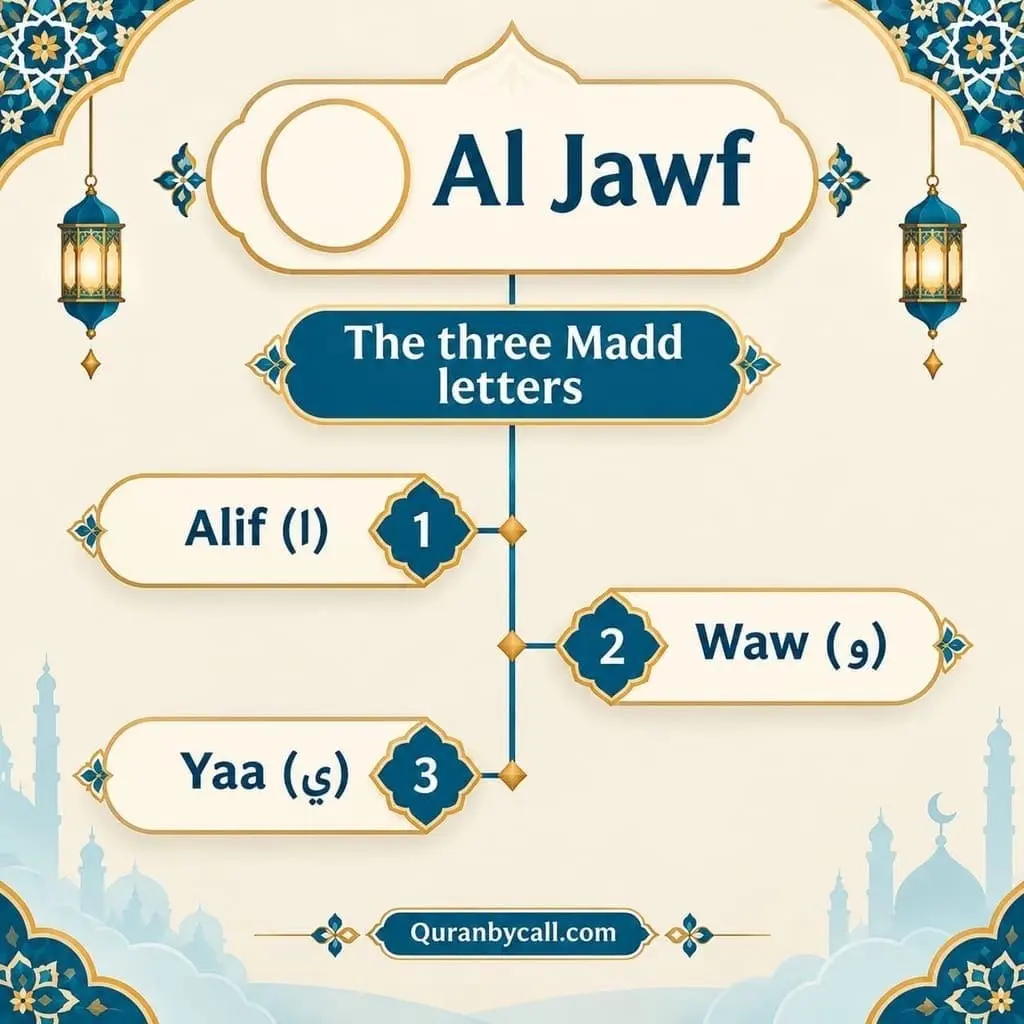
The Quran has a unique sweetness, and Quranic recitation reaches its peak beauty when its sounds are elongated. This melodious vocal extension begins from a unique articulation point called Makhraj Al Jawf.
Table of Contents
Al-Jawf is the only Makhraj whose letters do not depend on collision or a specific point of contact; therefore, it is an estimated (Muqaddar) articulation point.
It is the first Makhraj in Tajweed, representing the open cavity of the mouth and throat.
Its letters are the three Madd letters: Alif (أ), Waw(و), and Ya (ي), which give the verses their balanced, faith-filled melody.
What you will learn in this article:-
1- This article will take you on a practical and simplified journey to break down the conditions of these letters
2- How to distinguish these letters from similar-sounding letters
3- Avoiding the most common pronunciation mistakes with practical exercises
What is Makhraj Al Jawf and Why is it Called an Estimated Articulation Point?
Linguistically, Al-Jawf means emptiness or an extended void.
In Tajweed terminology, Makhraj Al Jawf is the open, extended cavity that stretches from the throat, through the mouth, to the lips.
It is called the estimated (Muqaddar) articulation point because there is no point of contact; the sound exits within it along with exhaled air without colliding with a specific part of the mouth such as the tongue, teeth, or lips.
What is the difference between a realized (Muhaqqaq) and an estimated (Muqaddar) Makhraj?
Realized points depend on a specific point of contact, whereas Al-Jawf, as an estimated point, ends when the sound and breath dissipate into the air.
Its letters are the three Madd letters: Alif, the silent Waw preceded by a Dammah, and the silent Ya preceded by a Kasrah.
They are airy letters (Huruf Hawa’iyyah) that have a natural extension with vowels: Fathah, Dammah, and Kasrah.
Imam Ibn Al-Jazari placed the letters of Al-Jawf at the beginning of the articulation points because it is the vastest and most fluid in its flow.
The Three Madd Letters in Tajweed: Simple Conditions for Alif, Waw, and Ya
The Makhraj Al Jawf articulation point produces only three specific letters known as the Madd (elongation) letters: Alif, Waw, and Ya, which are collectively found in the famous word “NUHIHA” (نُوحِيهَا).
Conditions for each letter:
1- Alif: It is always Sakinah (silent) and must always be preceded by a Fathah, as in: QALA (قَالَ).
2- Waw: It must be Sakinah and preceded by a suitable Dammah, as in: YAQULU (يَقُولُ).
3- Ya: It must be Sakinah and preceded by a suitable Kasrah, as in: QILA (قِيلَ).
The letters of Al-Jawf are not rigid sounds, but rather an extension and prolongation of short vowels; Fathah becomes Alif, Dammah becomes Waw, and Kasrah becomes Ya. The natural duration of Madd is two Harakahs (the standard measure).
Alif is the easiest of them because it only ever appears as a Madd letter, while for Waw and Ya one must check the preceding vowel.
How Does Sound Come Out of Al Jawf Without Tongue Contact?
1-Mechanics of airflow and sound, where sound begins with the vibration of the vocal cords in the larynx, then passes through the open tract of Al-Jawf and flows with exhaled air without any obstruction or collision.
2-Role of the tongue and articulators:
- The tongue is in a resting position or in a position that minimizes narrowing of the sound tract without touching any specific point on the palate or teeth.
- Mouth and lips: the mouth only takes the shape designated for the accompanying vowel, by opening for Alif, rounding the lips for Waw, or lowering the lower jaw for Ya.
3-Natural Madd and its timing:
This free flow is what produces the natural Madd (Madd Tabi’i) with a duration of two Harakahs.
Controlling the two Harakahs is like the time it takes to open and close a finger, to ensure the sound is not excessively prolonged or shortened.
Producing the sound from Makhraj Al Jawf requires complete relaxation of the throat and tongue muscles, and any muscular tension spoils the sound and takes it away from its comfortable, natural Madd quality.
Madd Letters vs Leen Letters: How to Tell the Difference Quickly
The letters Waw and Ya have two distinct roles in Tajweed; they can be either Madd letters in Tajweed from Makhraj Al Jawf, or Leen (soft) letters from their realized articulation points.
To distinguish between them:
| Feature | Madd letters | Leen letters |
| Letters | Alif, Waw, Ya (in نُوحِيهَا ) | Waw, and Ya only |
| Condition | Sakinah + Homogeneous vowel (fathah before Alif , Dammah before Waw, kasrah before Ya). | Sakinah + fathah before both |
| Makhraj | Al-Jawf (Estimated -Muqadder) the empty cavity of mouse & throat | Realized (Muhaqwaq) – Waw from Lips,Ya from middle of tongue |
| Nature of sound | Prolonged & Airy – Extension of the vowel in open space | Soft & easy – flowes gently without prolonged |
| Duration (wasl) | 2 Harakahs (Madd Tabi’i) | No Madd, pronounced softly and quickly |
| Example | قَالَ/ يَقُولُ / قِيلَ | خَوْف / بَيْت |
| Common mistakes | Shortening it to less than 2 Harakahs | Prolonged it like a Madd letter when continuing |
How to Spot Al Jawf Elongation in the Quran: Practical Examples
How to recognize the letters of Al-Jawf visually just by looking at the page?
By searching for the three binary combinations: Fathah + Alif, Dammah + Waw free of any vowel, and Kasrah + Ya free of any vowel.
Observing the signs of the Uthmani Mushaf script:
The small dagger Alif (Alif Khanjariyyah) as in AR-RAHMAN (الرَّحْمَـٰنِ) is treated exactly like a regular Alif, as a Jawfi Madd of two Harakahs.
The distinguishing Alif (Alif Fariqah) written after Waw Al-Jama’ah as in QALU (قَالُوا۟) is written but not pronounced and is not considered a Madd letter.
Examples from the Holy Quran:
1-In Surah Al-Fatiha: MALIKI (مَالِكِ) (Madd Alif), AR-RAHEEM (الرَّحِيمِ) (Madd Ya), and AD-DALLIN (الضَّالِّينَ) (combines Alif and Ya).
2-Surah Al-Ikhlas: an example of Madd Waw in YULAD (يُولَدْ).
3-(Surah Hud): The word NUHIHA (نُوحِيهَا) which gathers the three letters of Al-Jawf consecutively in one word (NU – Madd Waw, HI – Madd Ya, HA – Madd Alif).
These same Jawfi letters may be prolonged for more than two Harakahs if they meet a Hamzah or Sukun in other rules, such as Madd Munfasil in YA AYYUHA (يَا أَيُّهَا).
4 Common Mistakes in Makhraj Al Jawf and How to Fix Them
1- Truncating and Stealing the Madd (Batr al-Madd wa Ikhtilasuhu):
This is shortening the duration of the natural Madd to less than two Harakahs due to speed, so the Madd letter turns into a short vowel, like pronouncing QALA (قَالَ) as if it were QALA with a short vowel (قَلَ).
The solution lies in slowing down and maintaining a regular rhythmic count (two Harakahs) to give the air enough space to exit from Makhraj Al Jawf.
2- Over-stretching the Madd beyond two Harakahs (Over-elongating Madd Tabee’i):
This is dragging the sound and increasing it beyond two Harakahs without a Tajweed reason such as Hamzah or Sukun.
The solution is to adhere to the natural measure of two Harakahs and not exaggerate unless there is a Tajweed rule that permits the increase (Madd Munfasil or Muttasil).
3- Muscle tension and throat pressure, which is searching for a specific point of contact like the rest of the articulation points, leading to contraction of the throat muscles, retraction of the tongue backwards, and distortion of the sound.
The solution: Complete relaxation of the jaw, throat, and tongue muscles and letting the air flow smoothly in the open cavity.
4- The fourth and final mistake is confusing Leen letters with Madd letters:
That is, treating the silent Waw and Ya preceded by a Fathah (like BAYT (بَيْت) or KHAWF (خَوْف)) as if they were Jawfi Madd letters by prolonging them two Harakahs when continuing recitation.
The solution: Always check the vowel preceding the letter; if it is a Fathah, the letter should be pronounced softly and smoothly without long prolongation.
Start your Qur’an journey now with our online Quran course.
A 3-Minute Practical Drill to Master Makhraj Al Jawf
In the first minute there is the isolation and relaxation control exercise, and its goal is that you must perceive the sound exiting from the open cavity without any muscle tension.
Its application is by pronouncing a short vowel then prolonging it smoothly while maintaining the mouth position, such as QA (قَ) then continuing for two Harakahs.
Ensure complete relaxation of the tongue and throat without searching for a point of contact.
In the second minute, there are the training binaries/triads, and their goal is to train the mind and tongue to combine and transition between the three letters of Al-Jawf.
By repeating model words 5 to 10 times with a clear voice and regular rhythm, such as:
Alif word: QALA (قَالَ) / MALIKI (مَالِكِ).
Waw word: YAQULU (يَقُولُ) / YULAD (يُولَدْ).
Ya word: QILA (قِيلَ) / AR-RAHEEM (الرَّحِيمِ).
The word combining all 3 letters: NUHIHA (نُوحِيهَا).
And in the third minute, there is imitation and voice recording, which we do to discover self-errors and clearly evaluate the duration of the two Harakahs.
This is done by listening to a short Ayah from a proficient reciter famous for slow recitation, such as Sheikh Al-Husary.
Also, record your own voice on your phone while reading the same Ayah and compare the recordings in terms of the length of the Madd, avoiding stealing it or over-stretching it.
To master Tajweed, you must practice daily in a simple way, and you should book a free trial lesson with a specialized teacher to get direct correction and feedback on your pronunciation of Makhraj Al Jawf .
Conclusion
Mastering Makhraj Al Jawf is the very cornerstone of a melodious and balanced Quranic recitation, as it gives the Madd letters their due right of smooth flow and fluidity without complication.
Understanding the theoretical rules of Al-Jawf is only the beginning; the true secret to mastery lies in consistent practice and direct oral transmission (Mushafahah) under a proficient teacher.
Do not hesitate to begin your practical journey of applying the rules of Makhraj Al-Jawf today.
Book your free trial session now to receive direct guidance and precise correction for your pronunciation of the Madd letters from Al-Jawf.
FAQS
What are the 5 main Makharij?
- 1. Al-Jawf (The Oral Cavity): It is the extended empty space in the throat and mouth. It is an estimated (Muqaddar) Makhraj.
Its letters are the three Madd letters: Alif, the Madd Waw, and the Madd Ya.
- Al-Halq (The Throat): It contains three specific Makharij: Aqsa Al-Halq (deepest part), Wasat Al-Halq (middle), and Adna Al-Halq (closest part).
It has six Idh-har letters: Hamzah and Ha from the deepest part, ‘Ayn and Ha from the middle, and Ghayn and Kha from the closest part.
- Al-Lisan (The Tongue): It is the largest of the general Makharij and contains ten specific Makharij.
It produces 18 letters, including: Qaf, Kaf, Jim, Shin, Ya Ghayr Maddiyyah, Dad, Lam, Nun, Ra, Dal, Ta, Dha, Dhal, Tha, Sad, Sin, and Zay.
- Ash-Shafatan (The Two Lips): They contain two specific Makharij: the inner part of the lower lip, and the closing/touching of both lips.
Its letters are four: Fa, Waw Ghayr Maddiyyah, Ba, and Mim.
- Al-Khayshum (The Nasal Cavity): It is the nasal cavity extending above the roof of the mouth. It is an estimated (Muqaddar) Makhraj.
The sound of Ghunnah, which accompanies only Nun and Mim, emanates from it.
What is Makharij in Tajweed?
Linguistically, Makharij is the plural of Makhraj, meaning the place of exit.
Technically in Tajweed, it is the specific, defined point from which a letter emerges and by which it is distinguished from other letters upon pronunciation.
Letters are produced when exhaled air and human voice are transformed into a distinct, specific letter upon its interruption or passage through a particular Makhraj.
The importance of studying these Makharij lies in protecting the tongue from errors and Lahn (melodic mistakes) during Quran recitation, distinguishing between letters that are similar in characteristics (like Ta(ت) and Ta( ط)) or close in Makhraj, and giving each letter its right and due to achieve the authentic, eloquent Arabic pronunciation.
How many Makharij are there?
The main schools of thought among Tajweed scholars:
- The First School: The view of the majority, including Imam Ibn Al-Jazari and Al-Khalil ibn Ahmad. It consists of 17 specific Makharij divided among 5 general Makharij. This is the most adopted, famous, and widely taught view.
- The Second School: The view of Imam Ash-Shatibi and Sibawayh. It consists of 16 specific Makharij, after eliminating the Makhraj of Al-Jawf and distributing its letters among the throat, tongue, and lips.
- The Third School: It consists of 14 specific Makharij, by eliminating Al-Jawf and considering the tongue as a single Makhraj. Difference between General and Specific Makharij:
The general Makharij are the major areas of the vocal apparatus, while the specific Makharij are the precise, defined points within each general area.
External links: Watch this Video is explaining Makhraj Al jawf ( https://youtu.be/ZhTQJR8KaxY?si=h-QnNyaxfpxdusPR)