

This article explains the difference between Lam Qamariyyah and Shamsiyyah, Al-Lam Qamariyyah and which needs clear pronunciation, and Al-Lam Al-Shamsiyah, where the letter blends with the next sound, includes practical examples from scripture, like the phrases for “The All-Forgiving” and “The Peace,” to show these different phonetic uses, Furthermore,we will examine how this prefix works in relative pronouns and the Divine Name, Allah, serving as a helpful guide for students aiming to perfect their recitation and pronunciation of Arabic.
Table of Contents
What are the main differences between Lam Lam Qamariyyah and Shamsiyyah?
The primary distinctions between Lam Qamariyyah and Shamsiyyah pertain to the pronunciation and visual representation of the letter Lam in the definite article (Al-Ta’rif) as found in the Quran. According to various sources, the differences are outlined as follows:
1. Pronunciation Rule Lam Qamariyyah
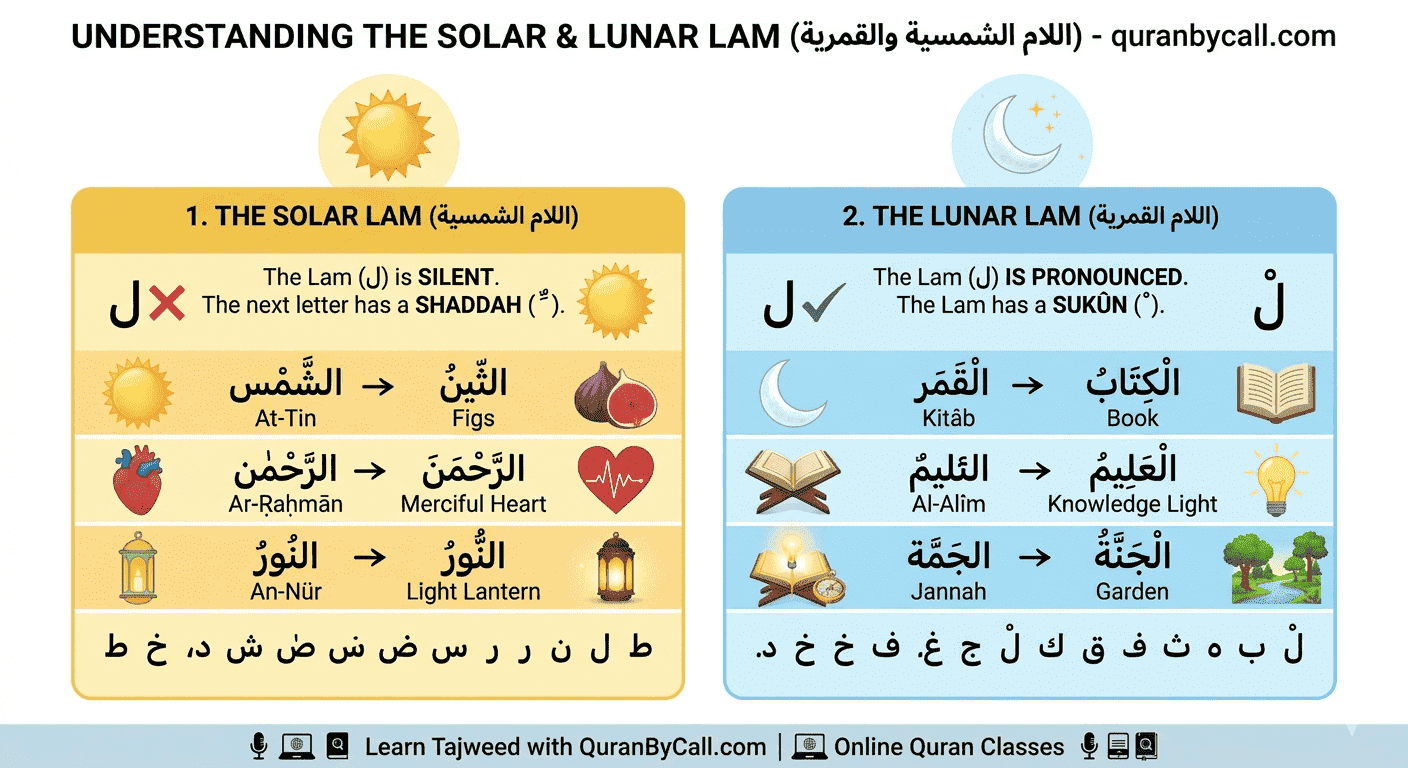
Lam Qamariyyah necessitates Idhaar, which means that the letter Lam is articulated distinctly.
Lam Shamsiyyah: This rule entails the merging of the Lam with the subsequent letter (Idgham), as illustrated by the term As-Salam.
2. Visual Identification Lam Qamariyyah
- Lam Qamariyyah: can be visually recognized by the presence of a sukoon mark directly on the letter Lam.
- Lam Shamsiyyah: Visually, this is indicated by the lack of a sukoon on the Lam and typically a shaddah on the following letter, as demonstrated in the example of As-Salam.
3. Examples of Lam Qamariyyah and Shamsiyyah
- Examples of Lam Qamariyyah including Al-Ghafoor, Al-Hakeem, Al-Kabeer, Al-Aziz, Al-Muhajireen, Al-Quddoos, and Al-Huda.
- An example of Lam Shamsiyyah: The main example cited is As-Salam.
4. Occurrence and Context Both types of Lam are preceded by Hamzat al-Wasl (the connecting Alif).
Furthermore, these rules for the definite article appear in the name of Allah and in relative pronouns (Asma’ al-Mawsula), such as Al-ladhi, Al-lati, Al-lawati, and Al-ladheena.
How the Arabic letter “Lām (ل)” is articulated ( Makharij)?
How does the definite article change when using relative pronouns?
- When employing relative pronouns (Asma’ al-Mawsula), the definite article (Al-Ta’rif) is inherently integrated into the term.
- The references classify these pronouns as particular cases where the principles of the definite article are utilized.
- We can illustrate the application of the definite article in this context through the following relative pronouns:
- Al-ladhi (الذي)
- Al-lati (التي)
- Al-lawati (اللواتي)
- Al-ladheena (الذين)
- Al-ladhayn (اللذين)
We can categorize these pronouns with other terms that include the definite article, such as the Name of Allah, indicating that they adhere to the same structural guidelines of Lam Sakinah present in Al-Ta’rif.
Start Your Quran Learning Journey with Quran by Call
Learn Lam Qamariyyah and Shamsiyyah with confidence and clarity at Quran by Call. Whether you are a beginner or improving your recitation, our simple and effective lessons help you understand, pronounce, and connect with the words of Allah in an easier way. Start your Quran learning journey today and discover a more guided, meaningful, and inspiring experience.
Start now and take the first step toward better Quran reading and understanding.
What are shamsi and qamari letters?
- Qamariyyah Letters (Letters of Clarity/Idhaar): often remembered by the phrase “Ibghi Hajjaka wa Khaf ‘Aqeemahu” (إبغ حجك وخف عقيمه), Ghain (غ) from Al-Ghafoor, Ha (ح) from Al-Hakeem, Kaf (ك) from Al-Kabeer, ‘Ain (ع) from Al-Aziz, Meem (م) from Al-Muhajireen, Qaaf (ق) from Al-Quddoos and Al-Qawm, and Ha (هـ) from Al-Huda.
- • Shamsiyyah Letters (Letters of Merging/Idgham): consist of the remaining 14 letters (such as Ta, Tha, Dal, Dhal, Ra, Zay, Seen, Sheen, Sad, Dad, Ta, Za, Lam, and Nun), Seen (س) from As-Salam, and Lam (ل) from the relative pronouns (Al-ladhi, Al-lati, Al-lawati, Al-ladheena) and the Name of Allah.
Examples of Lam Qamariyyah and Shamsiyyah:
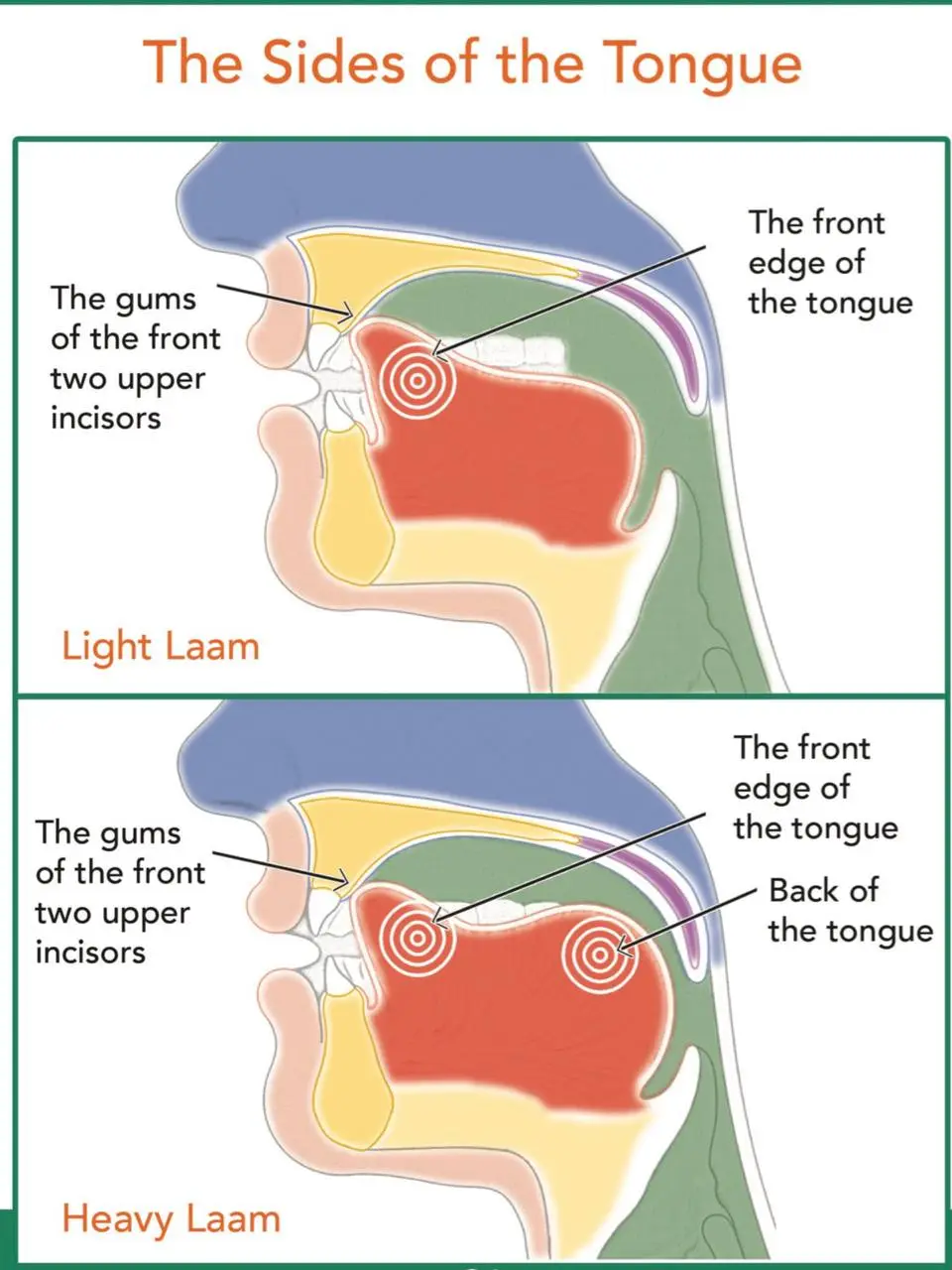
The letter ل is produced by pressing the sides of the front tongue along with the tip against the upper gumline, specifically the area behind the upper incisors, lateral incisors, canines, and premolars. This side‑contact is what gives the Lām its characteristic sound.
When pronouncing a heavy (thick) Lām, such as in certain cases of the Divine Name “Allah,” the back of the tongue rises toward the roof of the mouth, creating a fuller, deeper resonance.
What are the pronunciation errors of Lam letter?
- Using only the tip of the tongue, which weakens the sound.
- Accidentally merging the Lām with the following letter, especially nūn, because their articulation points are close.
- Making the Lām heavy in words where it should remain light.
- Adding qalqalah to a sukūn Lām, which is incorrect since Lām never has qalqalah.
What are the visual rules for the name of Allah?
In the Name of Allah, the definite article (Al-Ta’rif) follows the visual rules associated with Lam Shamsiyyah.
The visual markings for the name of Allah are as follows:
- Absence of Sukoon: Similar to other words with a merged Lam, the first Lam in the Name of Allah does not carry a sukoon mark.
- Presence of Shaddah: The letter following the first Lam (the second Lam) carries a shaddah. This visual cue signifies Idgham (merging), where the first Lam is merged into the second one during pronunciation.
- Hamzat al-Wasl: The word begins with Hamzat al-Wasl (the connecting Alif), which is the standard starting point for words containing the definite article in the Quran.
The Name of Allah alongside relative pronouns (Asma’ al-Mawsula).
What are the rules for relative pronouns like Al-ladhi?
The relative pronouns (Asma’ al-Mawsula) like Al-ladhi are specific instances where the definite article (Al-Ta’rif) is a built-in part of the word structure.The rules for these pronouns include:
- Inclusion of the Definite Article: Words such as Al-ladhi (الذي), Al-lati (التي), Al-lawati (اللواتي), Al-ladheena (الذين), and Al-ladhayn (اللذين) are all categorized as containing the definite article Al-Ta’rif.
- Merging (Idgham): These pronouns follow a pattern similar to Lam Shamsiyyah, where the Lam of the definite article is merged into the following letter,. In these cases, the Lam is merged into another Lam, which is why you see a shaddah on the second Lam and do not pronounce the first Lam clearly as a separate entity.
- Starting with Hamzat al-Wasl: Just like other words with a definite article, these pronouns are preceded by Hamzat al-Wasl (the connecting Alif),.
- Similarity to the Name of Allah: The sources note that the rule for the definite article in relative pronouns is the same as the rule applied to the Name of Allah.
In summary, the rule for relative pronouns is one of integration; the definite article is an inseparable part of these words, and they are pronounced using the principle of merging (Idgham), visually indicated by the shaddah on the Lam.
FAQ of Lam Qamariyyah and Shamsiyyah?
1) What is the difference between Lam Qamariyyah and Shamsiyyah?
Lam Qamariyyah is pronounced clearly, while Lam Shamsiyyah is not pronounced and merges with the next letter.
2) How can I identify Lam Shamsiyyah?
If the letter after “Al-” is one of the sun letters, the Lam is silent and the next letter is emphasized.
3) How can I identify Lam Qamariyyah?
If the letter after “Al-” is one of the moon letters, the Lam is pronounced clearly.
4) Is Lam Shamsiyyah written or pronounced in the Quran?
It is written, but not pronounced in recitation.
5) What are some examples of Lam Shamsiyyah?
Examples include Ash-Shams and An-Nas.
6) What are some examples of Lam Qamariyyah?
Examples include Al-Qamar and Al-Kitab.
7) How many sun letters are there?
There are 14 sun letters in Arabic.
8) How many moon letters are there?
There are 14 moon letters in Arabic.