
Table of Contents
Surah Al-Falaq with English Translation is considered one of the short surahs in the Holy Quran. But it carries great meanings and strong indications about protection and seeking refuge in Allah from different evils. And it is one of the surahs that Muslims make sure to read daily within the remembrances and regular prayers. Why? Because of its great virtue in spiritual and psychological fortification. Many readers search for it using different spellings, like falak surah, when looking for its meaning and benefits.
And in this guide, we will cover the explanation of Surah Tul Falaq, its benefits, its meanings, its English translation, and its specific tajweed rules. In detail.
Benefits of Reciting Surah Al-Falaq
Surah Al-Falaq with English Translation has a number of important spiritual and psychological benefits. And the most notable ones are:
- Fortification from envy and the evil eye – it is one of the most important surahs recited for protection from envy. It is also known in some regions as sorat falak among people who recite it for daily protection.
- Protection from magic because it points to seeking refuge from “the blowers in knots”.
- Psychological comfort and tranquility – it gives the heart a feeling of safety when you keep reading Surah Falak regularly.
- Strengthening the connection with Allah because it reminds the servant that Allah is the only refuge.
- Part of Al-Mu’awwidhatayn, and it is read with Surah An-Nas in the morning and evening remembrances.
Some interpreters mentioned that Surah Al-Falaq was revealed when the Prophet ﷺ was exposed to magic. So Allah revealed this surah with Surah An-Nas to be a means of seeking refuge and protection. And from here came the strength of the surah in repelling magic, envy, and everything that harms a person in his life.
Sahih International Surah Al-Falaq
It came in the international tafsir of “Surah Al-Falaq” that the surah is considered one of the Mu’awwidhatayn. And it is one of the Surahs that was revealed to strengthen the concept of seeking refuge in Allah from hidden and apparent evils.
And the surah shows that evil is not only in tangible things. It could be in darkness, envy, or even the hidden intentions of people.
Also, the tafsirs confirm that Surah Falaq is considered a comprehensive protection for the believer in his daily life. And it connects him to Allah at all times.
Why choose Quranbycall.com to learn Quran?
At Quran by Call, we aim to make Quran learning accessible and trustworthy for every reader. This Surah Al-Falaq page provides a clear English translation, Arabic text, and transliteration to help you recite with confidence, understand the meaning, and connect more deeply with the message of the Quran. Contact us for Free Trial class.
What The Daybreak surah Protects From
Surah Al-Falaq with English Translation includes protection from four main types of evils. That is why reciting Surah al-Falaq is recommended for daily fortification:
- The evil of what Allah created – meaning all creatures that might carry harm.
- The evil of the night and darkness when danger spreads, and safety disappears.
- Magic and sorcery – referred to as “the blowers in knots”.
- Envy and the evil eye are among the most dangerous types of psychological and spiritual harm.
Pronunciation Guide by Verse
When reciting Surah Al-Falaq with English Translation, you should observe some rules:
- Qul a’oodhu: Show the dammah on the word “a’oodhu”.
- Al-Falaq: Lighten the lam because it has a kasrah.
- Ghaasiqin idha waqab: Merge the silent noon into the ghayn.
- An-Naffaathaati: Show the shaddah on the faa and the thaa.
- Haasidin idha hasad: Natural madd in “idha”.
Sticking to tajweed makes the recitation correct. And spiritually impactful.
Revelation, number of verses, and core theme
- The Book: The Holy Quran
- Number of Verses: Only 5 verses
- The Main Theme: Seeking refuge in Allah from different evils
Surah Al-Falaq is one of the Meccan surahs. And it’s short. But it’s powerful in its meaning. And it comes within Juz’ Amma, which makes it easy to memorize and recite.
English Translation of Surah Al-Falaq
In the name of Allah, the Most Gracious, the Most Merciful
Say, “I seek refuge in the Lord of daybreak.
From the evil of what He created
And from the evil of darkness when it settles
And from the evil of those who blow on knots
And from the evil of an envier when he envies.”
Surah Al-Falaq Arabic text
بِسْمِ اللَّهِ الرَّحْمَٰنِ الرَّحِيمِ
قُلْ أَعُوذُ بِرَبِّ الْفَلَقِ
مِنْ شَرِّ مَا خَلَقَ
وَمِنْ شَرِّ غَاسِقٍ إِذَا وَقَبَ
وَمِنْ شَرِّ النَّفَّاثَاتِ فِي الْعُقَدِ
وَمِنْ شَرِّ حَاسِدٍ إِذَا حَسَدَ
It was reported from the Prophet ﷺ that he used to make sure to recite the Mu’awwidhatayn (Surah Al-Falaq and Surah An-Nas) in the morning and evening remembrances, and before sleeping. Why? Because of their great effect in protection from evils.
Also, he ﷺ used to blow them over his body when he was sick or felt harm. And this shows their great status in spiritual protection.
Word-by-Word Meaning
Surah Al-Falaq English Translation calls the human being to turn to Allah the Exalted. The Lord of Al-Falaq – meaning the Creator of the morning and the light – is asking for protection from all types of evils.
And these evils include everything that might afflict a person from apparent or hidden harm. Whether it is from Allah’s creatures, or from envy, or magic, or darkness.
The general meaning of the surah is teaching the human being that the real strength is in seeking refuge in Allah alone. Because He alone is the One capable of repelling harm and evil.
Surah Al-Falaq with Tajweed Rules
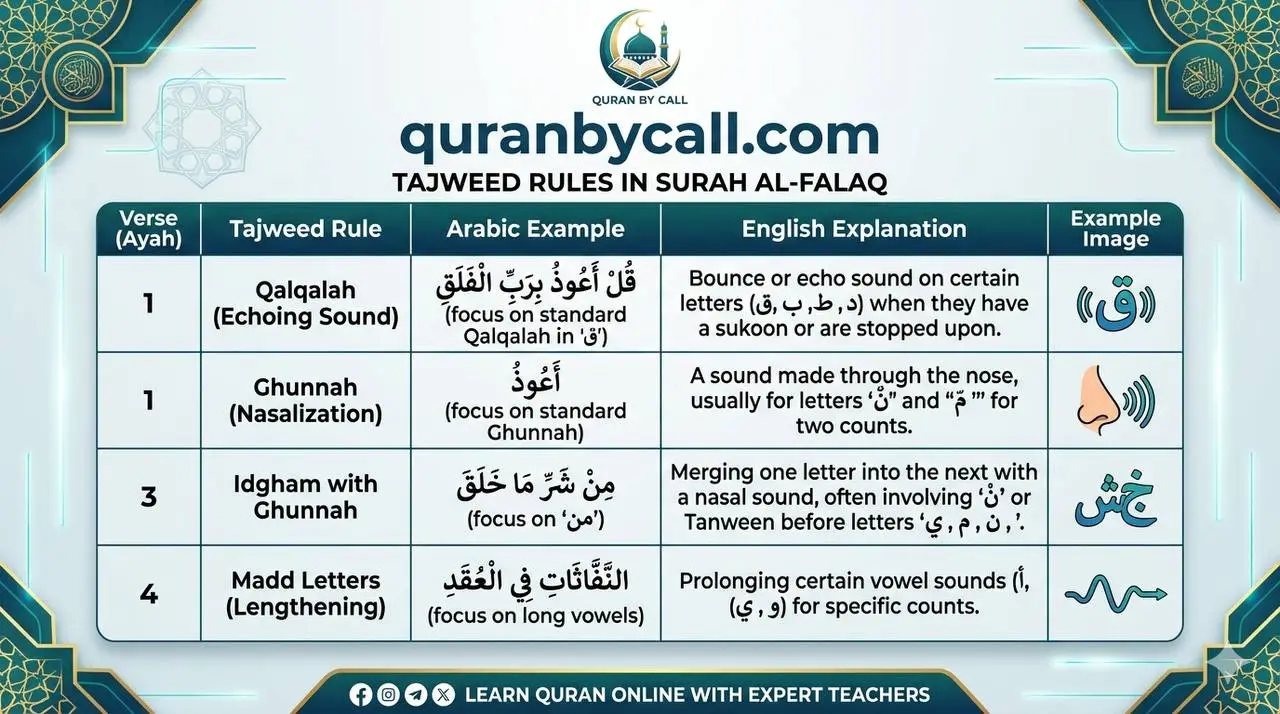
Surah Al-Falaq with English Translation contains several important tajweed rules, including:
- Qul: The Qaaf is given third-degree tafkheem. As for the Laam, it is saakin, occurs in the middle of the word, and is pronounced with tarqeeq.
- A’oodhu: The hamzah is pronounced with tarqeeq, and the letter “Ayn” is also pronounced with tarqeeq. The Waaw is elongated for two counts. The Dhaal is pronounced with tarqeeq while observing the qualities of infitaah and isti‘laa in it.
- Bi-rabbi: The preposition Baa is pronounced with tarqeeq, and the Raa is given second-degree tafkheem. The final Baa is pronounced with tarqeeq and carries a kasrah.
- Al-Falaq: It begins with a hamzat al-wasl that is pronounced with a fathah. The Laam is a lunar laam that is clearly pronounced and has tarqeeq. The Faa is also pronounced with tarqeeq, as is the second Laam. The Qaaf is pronounced with tafkheem and carries a medium-level qalqalah.
- Min sharri: The Meem is pronounced with tarqeeq. The Noon is an original saakin letter with no vowel. The Sheen is one of the letters of ikhfaa, so the rule here is ikhfaa with a ghunnah for two counts. As for the Raa, it is pronounced with tarqeeq because it carries a kasrah.
- Maa khalaq: The Meem is pronounced with tarqeeq. The Alif is a madd letter elongated for two counts. The Khaa is given second-degree tafkheem. The Laam is pronounced with tarqeeq, and the Qaaf is pronounced with tafkheem and qalqalah.
- Wa min sharri: The Noon is saakin and is followed by the letter Sheen, which is one of the letters of true ikhfaa, so the rule is ikhfaa with a ghunnah for two counts. The Raa is pronounced with tafkheem.
- Ghaasiq: The Ghayn is pronounced with tafkheem. The Alif and the Seen are both pronounced with tarqeeq. The Qaaf has relative tafkheem because it carries a kasrah, and the noon of tanween with kasr is saakin, and its rule is izhaar.
- Waqab: The Waaw is pronounced with tarqeeq, the Qaaf with tafkheem, and the Baa with tarqeeq whether in continuation or when stopping. Its rule is qalqalah when stopping on it.
- Idha: The hamzah is pronounced with tarqeeq, the Dhaal is also pronounced with tarqeeq, and the Alif is elongated for two counts.
- Hasad: The Haa is pronounced with tarqeeq. The Seen is pronounced with tarqeeq and has the quality of hams. As for the Daal, it carries qalqalah.
Sticking to these rules helps improve the quality of recitation. It helps in understanding the spiritual meaning of the surah.
FAQS of Surah Al-Falaq with English Translation
What is the difference between Surah Al-Falaq and Surah An-Nas?
Surah Al-Falaq deals with protection from external evils like envy and magic. While Surah An-Nas focuses on internal evils like whispers.
Is Surah Al-Falaq enough for protection from envy?
It is a strong means of fortification. But it’s preferred to read it with the other remembrances to achieve comprehensive protection.
How many times is it recommended to read Surah Al-Falaq daily?
It is recommended to read it 3 times in the morning and 3 times in the evening. And also before sleeping, with Surah An-Nas and Al-Ikhlas.